Prisma Decimal is not a number: the silent NaN that corrupts money math
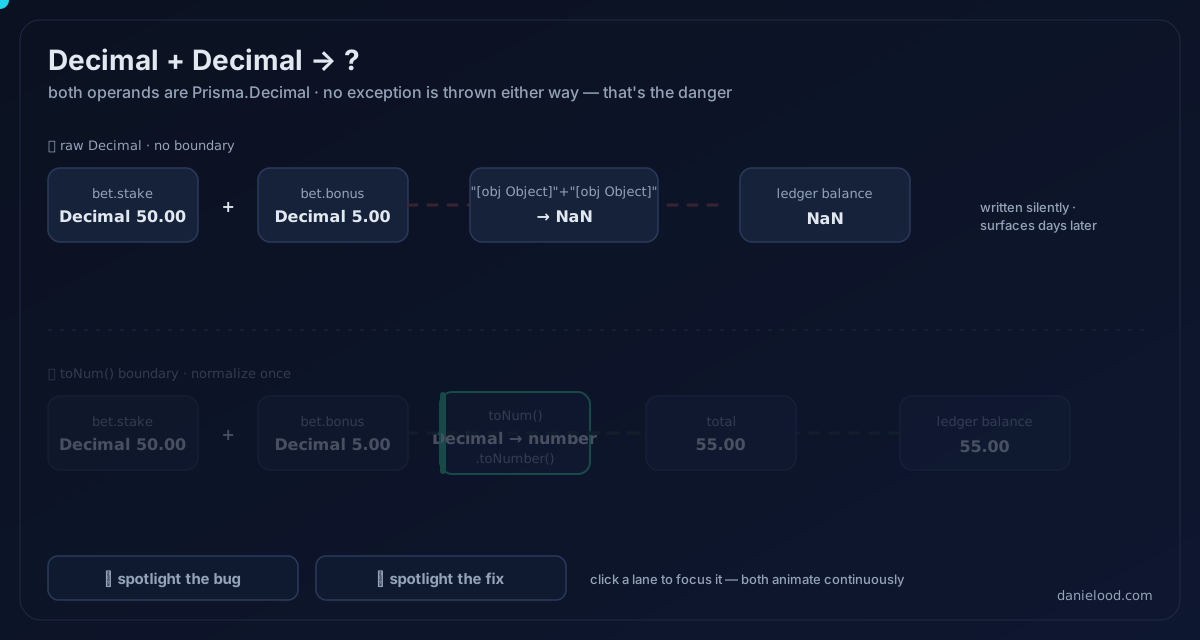
Prisma returns a Decimal object — not a JavaScript number — for decimal columns. Add two of them with + and you don't get their sum; you get "[object Object][object Object]", which coerces to NaN with no error thrown. The fix is to normalize at the boundary: convert every Decimal to a number (via .toNumber()) the moment it leaves the data layer, and never compare Decimal instances with ===. Do that in one place and the entire class of bug disappears.
Every senior engineer eventually meets a bug that isn't loud. It doesn't throw, doesn't page you, doesn't show up red in the logs. It just quietly writes the wrong number to a place where numbers matter. On a real-money betting platform, that place is a user's balance, and the wrong number is NaN.
This is the one I want to walk through, because the fix most people reach for is the wrong altitude — it patches the line instead of closing the door on the whole category.
The bug that doesn't throw
ORMs return rich types for a reason. Prisma hands you a Decimal object for decimal columns instead of a plain number, because number in JavaScript is a 64-bit IEEE-754 float, and floats lose money. 0.1 + 0.2 === 0.30000000000000004 is a party trick until it's a user's withdrawal. So Prisma protects you by keeping decimals as exact, arbitrary-precision objects.
The trouble is that a Decimal looks close enough to a number that ordinary code treats it like one — and JavaScript, faced with an operator it can't apply cleanly, coerces silently instead of failing honestly.
ts
// A settlement job, mid-refactor
const total = bet.stake + bet.bonus; // both are Prisma.Decimal
// The `+` operator can't add two objects, so JS calls toString() on each:
// "[object Object]" + "[object Object]" = "[object Object][object Object]"
// Downstream arithmetic on that string → NaN
No exception. No stack trace. The + operator, given two objects, falls back to string concatenation, and the resulting garbage string turns to NaN the first time it hits real math. That NaN then propagates through the payout calculation, gets written to the ledger as a balance, and surfaces days later as an accounting discrepancy that a human has to reconcile by hand — long after the deploy that caused it has scrolled off the top of your git log.
The reason it's so dangerous is precisely that it's quiet. A bug that throws is a bug that stops. This one keeps going, wearing the costume of a valid computation, right up until money is wrong.
Why the normal fix fails
The normal instinct is to fix the symptom where it hurts. You find the settlement job, wrap the offending line in a guard, sprinkle a Number(...) cast over it, confirm the ledger looks right in staging, and move on:
ts
const total = Number(bet.stake) + Number(bet.bonus); // "fixed"
And it is fixed — that line. But the bug wasn't a property of that line. It was a property of every place in the codebase where a Decimal meets an arithmetic operator, and you just fixed one of them. The next one is already written, somewhere in the payout engine or the commission calculator or a report query, waiting with a fresh disguise. Worse, the Number() cast you scattered here trains the next engineer to scatter more of them, so the real defect — that raw Decimal values are allowed to roam freely into business logic — is now harder to see, buried under a layer of local patches.
Normal practice treats the return type as a formality. It optimizes for making this line correct, not for making the class of bug impossible. Those are different goals, and only one of them scales.
The best-practice move: enforce the type at a boundary
Treat the ORM's return types as a contract, enforced at a single boundary. The moment a Decimal leaves the data layer, it gets normalized — deliberately, in one place — and the rest of the codebase never sees a raw Decimal in arithmetic again.
ts
import { Prisma } from "@prisma/client";

const toNum = (d: Prisma.Decimal | number): number =>
  typeof d === "number" ? d : d.toNumber();

// At the edge of the data layer, not scattered through business logic
const total = toNum(bet.stake) + toNum(bet.bonus);
Two rules make the whole category go away:
Convert explicitly at the boundary. Business logic works with number — or, for precision-critical paths like payout math, stays in Decimal end-to-end and uses Decimal methods (.plus(), .times()) the whole way. What you never allow is the silent mix, where a Decimal and a number meet an operator and hope for the best. You pick one representation per layer, and you convert at the seam between layers, on purpose.
Never compare Decimal instances with ===. This is the second half of the same trap, and it's sneakier:
ts
new Prisma.Decimal("10.00") === new Prisma.Decimal("10.00"); // false
Two Decimal objects holding the same value are still two different objects, and === is a reference check — it's asking "are these the same object in memory," not "are these equal in value." It will happily tell you 10.00 !== 10.00 and route a settled bet down the wrong branch. Use the value comparison the type gives you:
ts
a.equals(b);        // true
a.greaterThan(b);   // for ordering
A related sharp edge: never compare decimals as strings either. "9.90" < "10.00" is false in JavaScript, because string comparison is lexicographic — it compares character by character, and "9" sorts after "1". If a stringified decimal ever leaks into a < or >, your ordering silently inverts.
Make the illegal state unrepresentable
The rules above are correct, but rules that live only in your head get broken by the next tired engineer at 2am — possibly you. The deeper move is to make the mistake structurally impossible, so it's caught by a machine instead of a memory.
Two ways to do that, in increasing order of strength:
- A repository layer that only ever returns normalized primitives. Business code literally cannot get its hands on a raw
Decimal, because the data layer converts before handing anything back. The bug can't occur because the shape that causes it never crosses the boundary. - A lint rule that flags arithmetic on
Prisma.Decimal. Now the mistake fails in CI, in the pull request, before it's ever merged — a compile-time or review-time impossibility rather than a production incident.
Either one converts a recurring, silent, money-corrupting bug into something that simply can't ship. That's the whole point: you're not getting better at spotting the bug, you're arranging the world so the bug can't exist.
The checklist
If you're integrating Prisma (or any ORM with rich decimal types) into money code, this is the short version:
- Assume every decimal column comes back as an object, not a number.
- Normalize at the boundary — convert
Decimal → numberin one place as it leaves the data layer, or stay inDecimalend-to-end for precision-critical math. - Never do arithmetic on a raw
Decimalwith+,-,*,/. - Never compare
Decimalwith===(reference check) — use.equals(). - Never compare stringified decimals with
</>(lexicographic) — compare the values. - Enforce it with a repository layer or a lint rule, not with discipline.
The lesson
The gap between normal and best practice here isn't skill — it's altitude. Normal practice fixes the line. Best practice asks what kind of thing just went wrong and closes the door on all of it. One patches an incident; the other deletes a category.
When real money is on the line, the return type of a function isn't a detail. It's a promise — and promises get enforced at boundaries, not remembered one call site at a time.
I build correctness-critical payment and settlement systems in NestJS and TypeScript — the kind where a silent NaN is an outage. If that's the sort of thing keeping you up, let's talk.