The settlement job that quietly wrote NaN: a Prisma Decimal post-mortem
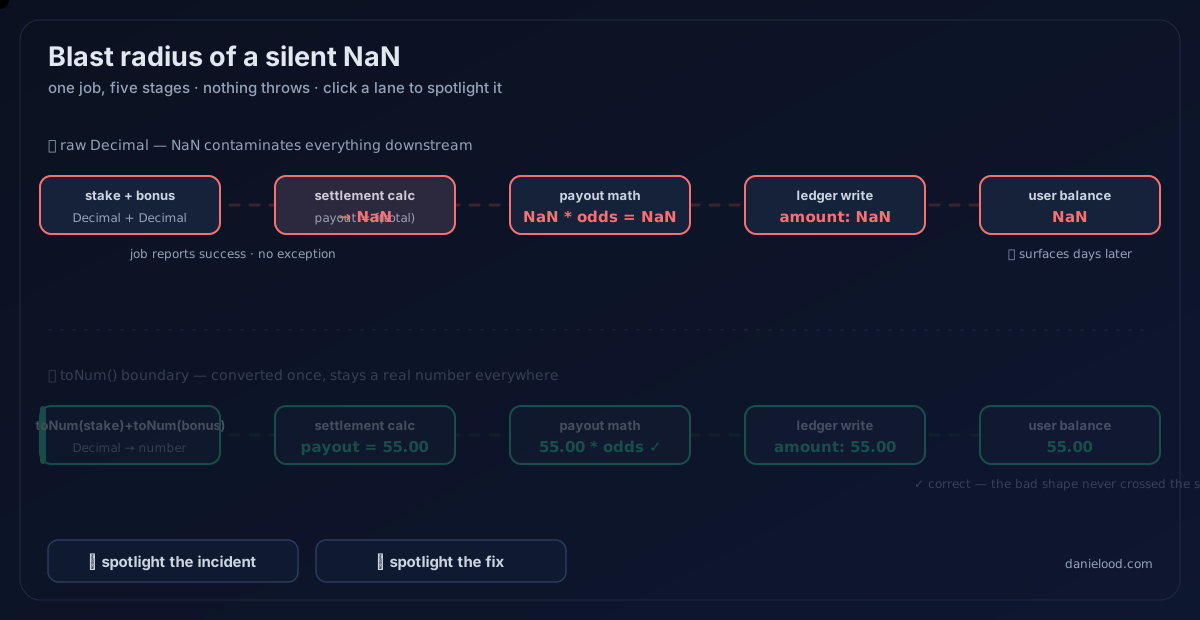
PlayZeet's bet-settlement job started writing amount: NaN to the ledger. The cause: Prisma returns Decimal objects — not native numbers — for decimal columns, and decimalA + decimalB (or a Decimal mixed with a number) coerces to NaN instead of throwing. The fix was to normalize at the boundary — convert every Decimal to a number with .toNumber() the moment it leaves the data layer, and never compare Decimal instances with ===. Here's how we found it and how we made it impossible to reintroduce.
Money code has no tolerance for surprises. So when the settlement job started stamping amount: NaN onto ledger rows, it went straight to the top of the list — ahead of every feature, ahead of everything. This is the write-up.
The symptom
The alert wasn't an exception. That's the first thing worth saying, because it's what made this dangerous. Nothing threw. Nothing paged. The job ran to completion, reported success, and moved on — it just happened to write NaN where a settled payout amount should be. We only caught it because a downstream balance check flagged that a handful of ledger entries had a non-numeric amount, and by then the job had run several times.
A bug that throws is a bug that stops. This one kept going, wearing the costume of a valid computation, right up until the numbers didn't add up.
Reproducing it
The settlement job's job is simple: take a bet, add up the parts, write the payout. Reduced to its essence, the line that broke looked like this:
ts
// bet.stake and bet.bonus are both Prisma.Decimal
const total = bet.stake + bet.bonus;
// total is now NaN — with no error at all
Locally it reproduced instantly. Log total and you don't see 55; you see NaN. Log the intermediate step and the reason jumps out:
ts
String(bet.stake) + String(bet.bonus);
// "[object Object][object Object]"
There it is. Prisma returns Decimal objects for decimal columns, on purpose — a JavaScript number is a 64-bit float, and floats lose money (0.1 + 0.2 is famously not 0.3). Keeping decimals as exact objects is Prisma protecting you. But the + operator can't add two objects, so JavaScript falls back to calling toString() on each, concatenates the results into "[object Object][object Object]", and that string turns to NaN the first time real arithmetic touches it. No coercion error, no type error — JavaScript would rather guess than fail.
The Decimal looked close enough to a number that the settlement code treated it like one, and the language obliged silently. That's the whole trap.
The one-line fix — and why it wasn't the fix
The tempting response is to patch the line that hurt:
ts
const total = Number(bet.stake) + Number(bet.bonus); // "done"
That makes this line correct. It does not make the bug go away, because the bug was never a property of this line — it was a property of every place in the codebase where a Decimal meets an arithmetic operator. The payout calculator, the commission engine, a report query: each one is the same defect wearing a different disguise, and casting this single call site does nothing for the others. Worse, scattering Number() casts trains everyone to keep scattering them, which buries the real problem — that raw Decimal values are allowed to roam into business logic at all.
So we fixed the class, not the line.
The actual fix: normalize at the boundary
Treat the ORM's return types as a contract enforced at one boundary. The instant a Decimal leaves the data layer, convert it — deliberately, in a single place — so the rest of the codebase never sees a raw Decimal in arithmetic again.
ts
import { Prisma } from "@prisma/client";

const toNum = (d: Prisma.Decimal | number): number =>
  typeof d === "number" ? d : d.toNumber();

// at the edge of the data layer, not sprinkled through business logic
const total = toNum(bet.stake) + toNum(bet.bonus);
Two rules make the category disappear. Convert explicitly at the boundary: business logic works in number, or — for precision-critical paths like payout math — stays in Decimal end-to-end using Decimal methods (.plus(), .times()). What you never allow is the silent mix. And never compare Decimal instances with ===, because that's the same trap from a different angle:
ts
new Prisma.Decimal("10.00") === new Prisma.Decimal("10.00"); // false
Two Decimal objects holding the same value are different objects in memory, and === is a reference check — it answers "same object?", not "same value?". It will cheerfully tell you 10.00 !== 10.00 and route a settled bet down the wrong branch. Use a.equals(b) for equality and a.greaterThan(b) / a.lessThan(b) for ordering. (A cousin of this bit us elsewhere: comparing stringified decimals with < is lexicographic, so "9.90" < "10.00" is false — string comparison walks character by character, and "9" sorts after "1".)
Making it impossible to reintroduce
Rules that live only in your head get broken by the next tired engineer at 2am. So the last step was to make the mistake structurally impossible rather than merely discouraged. Two levers, either of which closes the door:
A repository layer that only returns normalized primitives — business code can't get a raw Decimal because the data layer converts before handing anything back, so the shape that causes the bug never crosses the seam. Or a lint rule that flags arithmetic on Prisma.Decimal, which fails the pull request in CI, turning a production incident into a review-time impossibility. We reached for both over time; even one would have prevented the original write.
The lesson
The gap here wasn't skill — it was altitude. The quick fix asks "how do I make this line correct?" The durable fix asks "what kind of thing just went wrong, and how do I delete the whole category?" One patches an incident; the other prevents the next twelve.
When real money is on the line, a function's return type isn't a formality. It's a promise — and promises get enforced at boundaries, not remembered one call site at a time. The NaN was never really about arithmetic. It was about letting a rich type leak past the layer that was supposed to normalize it.
I build and debug correctness-critical settlement and payment systems in NestJS and TypeScript — the kind where a silent NaN is an incident, not a warning. If that's your world, let's talk.